
Korean Air safety record
No Korean Air flight has had a fatal accident for anyone on board since 1999 — more than 25 years — and its passenger flights have not had one since 1997. On airlines like Korean Air, the chance of being in a fatal accident is about 1 in 80 million per flight.
No fatal accident for anyone on board since 1999
KEFlying Korean Air? Know before you board.
- ✓Which aircraft is on your flight — the exact type and its record, updated if the airline swaps it
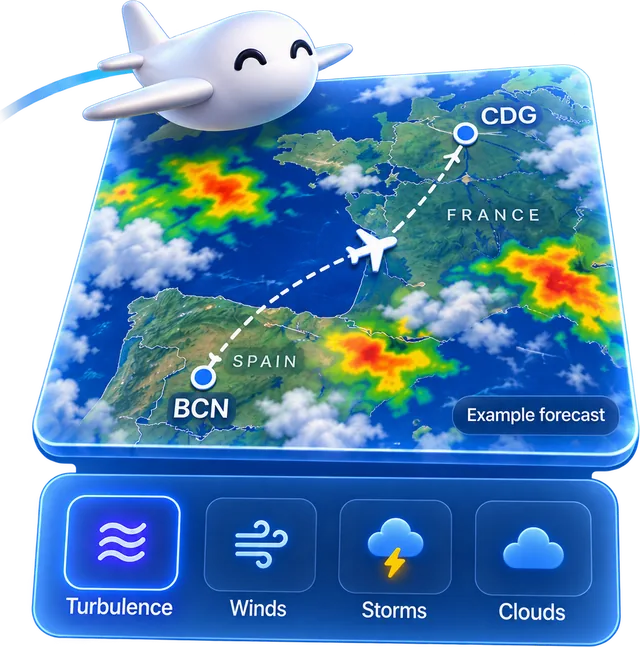
- ✓The turbulence forecast for your exact flight, refreshed as new weather comes in
- ✓Delays and gate changes on your Lock Screen, before the departure board
- ✓Where you are in the flight, and how long until the bumpy stretch is behind you
No fatal accident for anyone on board since 1999
Korean Air's record through the 1990s was poor, and it is set out in full on this page. The worst accident on its own flights was flight 801 in August 1997, a 747 that flew into high ground on approach to Guam at night, in rain; 228 of the 254 people on board lost their lives. The US investigators found the captain did not properly brief and fly the approach and the other two pilots did not cross-check him, and named his fatigue and Korean Air's inadequate crew training as contributing causes.
Earlier, a 747 touched down short of the runway at Seoul Gimpo in 1980 (flight 015), and a DC-10 crashed short of the runway in fog at Tripoli in 1989 (flight 803). In 1999 two of its cargo flights crashed after take-off: an MD-11 at Shanghai in April, where five people on the ground also lost their lives, and a 747 freighter near London Stansted in December. Everyone on board both aircraft, all of them crew, lost their lives.
What changed afterwards matters more. In 1999 Delta and Air France suspended their code-share partnerships with Korean Air over safety. Korean Air brought in a former Delta vice-president, David Greenberg, to run flight operations and safety, rebuilt its pilot training with Delta's help, and passed a joint audit by the two airlines; the code-shares resumed in 2002. In 2001 the US aviation regulator briefly downgraded South Korea's safety oversight, restoring the top rating in December after the government rewrote its aviation rules. Since the end of 1999, no one on board a Korean Air flight has lost their life in an accident.
In October 2022 flight 631, an A330, ran off the end of the runway at Cebu in the Philippines on its third landing attempt in bad weather; everyone on board got out. Investigators found a landing-gear wheel struck a step at the runway edge, leaving the aircraft without most of its braking, after an unstable approach.
Korean Air has also been the target of attacks. Soviet fighters fired on flight 902 in 1978, fatally injuring two passengers, and shot down flight 007 in 1983 with 269 people on board; in 1987 a bomb left by North Korean agents destroyed flight 858 over the Andaman Sea with 115 on board. These were crimes against the airline, not accidents, and are listed separately. Korean Air in its present form dates from 1969, when the Hanjin group bought the state-owned Korean Air Lines; Asiana Airlines, which it took control of in December 2024, still flies under its own name and is not counted here.
Every fatal accident, on one line
Solid dots are its own flights; hollow ones were flown by a partner or subsidiary under its name; grey rings are hijackings and attacks. Fatalities that investigators don't class as accidents (such as trespassers) aren't shown.
Each of these was investigated, and the lessons are built into how every airline flies today. The full list is here if you want it.
Read the full list (10)
- Dec 1999 KE8509 (cargo) · Boeing 747-200 freighter · Great Hallingbury, near London StanstedThe captain's attitude indicator was faulty after a poorly fixed instrument fault; he kept rolling left after take-off despite warnings, and the first officer did not intervene. All four on board lost their lives (UK AAIB report 3/2003).
- Apr 1999 KE6316 (cargo) · McDonnell Douglas MD-11 freighter · Shanghai, ChinaShortly after take-off the first officer wrongly confirmed a climb clearance of 1,500 metres as 1,500 feet; the captain pushed the nose down hard and the aircraft could not recover. All three crew lost their lives, and five people on the ground.
- Aug 1997 KE801 · Boeing 747-300 · Nimitz Hill, GuamFlew into high ground at night on approach in rain. The NTSB found the captain did not properly brief and fly the approach and the other pilots did not cross-check him; his fatigue and Korean Air's inadequate crew training contributed. 26 of the 254 on board survived.
- Jul 1989 KE803 · McDonnell Douglas DC-10-30 · Short of the runway, Tripoli, LibyaCrashed short of the runway in fog. Libyan investigators found the tired crew continued the approach below the minimum height without the runway in sight; 124 of the 199 on board survived.
- Nov 1980 KE015 · Boeing 747-200 · Seoul Gimpo AirportTouched down short of the runway in fog, hit an embankment and caught fire. Most of the 226 on board got out; 14 lost their lives, and one person on the ground.
- Aug 1976 Cargo flight (Tehran–Seoul) · Boeing 707 freighter · Near Tehran Mehrabad, IranAfter take-off the aircraft turned the wrong way off the published departure route and flew into high ground; all five crew lost their lives.
Hijackings and attacks — crimes against the airline, not accidents
- Nov 1987 KE858 · Boeing 707 · Andaman Sea, off MyanmarDestroyed by a bomb left on board by North Korean agents, who had got off at Abu Dhabi; all 115 on board lost their lives.
- Sep 1983 KE007 · Boeing 747-200 · Sea of Okhotsk, off SakhalinStrayed off course into Soviet airspace on the Anchorage–Seoul leg and was shot down by a Soviet fighter; all 269 on board lost their lives.
- Apr 1978 KE902 · Boeing 707 · Frozen lake near Kem, Soviet UnionStrayed into Soviet airspace on the Paris–Anchorage leg and was fired on by a Soviet fighter; two passengers were fatally injured in the decompression. The crew landed on a frozen lake.
- Jan 1971 Hijacking (Gangneung–Seoul) · Fokker F27 · Beach near Sokcho, South KoreaA hijacker demanding to be flown to North Korea set off a grenade in the cockpit as the co-pilot tried to stop him; both were fatally injured. The captain crash-landed on a beach and the other people on board survived.
Flying Korean Air soon? See the bumps on your route
Enter where you're flying from and to. The forecast shows where the bumpy stretches are, how strong they'll be and when in the flight they come, from global weather forecasts and live pilot reports.
The day you fly, in the departure airport's own calendar.
Korean Air in numbers
What Korean Air flies
Tap a plane for its own safety record.
Korean Air safety questions
How safe is Korean Air?
No Korean Air flight has had a fatal accident for anyone on board since 1999 — more than 25 years — and its passenger flights have not had one since 1997. On airlines like Korean Air, the chance of being in a fatal accident is about 1 in 80 million per flight. Every fact on this page is sourced — the list is at the bottom.
What is Korean Air's safety rating?
There is no single official safety rating for airlines; the scores some websites publish are their own formulas. What can be checked is the record: no fatal accident for anyone on board a Korean Air flight since 1999, with the events before that set out on this page. It is a member of IATA, the airlines' trade body, which requires its members to pass IATA's operational safety audit (IOSA).
Has Korean Air's safety improved?
Yes, and it is one of the best-documented turnarounds in aviation. After its accidents of the late 1990s, Delta and Air France suspended their partnerships with Korean Air in 1999. It brought in a former Delta executive to run flight operations and safety, rebuilt its pilot training, and passed a joint audit by the two airlines, which resumed their code-shares in 2002. No one on board a Korean Air flight has lost their life in an accident since 1999.
Where these facts come from
Every fact on this page comes from official accident reports, the airline's own figures or the published accident record.
- Wikipedia founding, hubs, fleet
- Wikipedia founding (Korean National Airlines, 1962 state takeover, 1969 sale to Hanjin)
- The Korea Times passengers 2024
- ch-aviation fleet (A350 in service, Jan 2025)
- IATA IOSA
- Aviation Safety Network accident record
- Aviation Safety Network accident record
- Aviation Safety Network accident record
- Aviation Safety Network accident record
- Wikipedia accident record
- Aviation Safety Network accident record
- Aviation Safety Network accident record
- Aviation Safety Network accident record
- Wikipedia accident record
- NTSB accident record (flight 801, AAR-00/01)
- Aviation Safety Network accident record
- CAAC / ARAIB joint investigation (via Aviation Safety Network) accident record (flight 6316)
- UK AAIB accident record (flight 8509, report 3/2003)
- Aviation Safety Network accident record
- Aviation Safety Network accident record (flight 631, Cebu 2022, no fatalities)
- Aviation Updates Philippines (on the CAAP final report) accident record (flight 631)
- US House Transportation Committee (archived, May 1999) 1999 code-share suspensions
- FlightGlobal safety overhaul under David Greenberg (2000)
- Aviation Week pilot training overhaul with Delta
- FlightGlobal code-shares restored (2002)
- Korea JoongAng Daily FAA Category 2 (Aug 2001) and restoration (Dec 2001)
- IATA IOSA registry IOSA registration (not read — see flags)
- MIT News / Journal of Air Transport Management (Barnett, 2024) risk per flight 2018–2022
Flying Korean Air soon?
FlyBud shows the exact aircraft on your flight and the turbulence forecast for your route.