
Jeju Air safety record
Jeju Air has had one fatal accident in twenty years of flying: flight 2216 at Muan, South Korea, in December 2024, in which 179 of the 181 people on board lost their lives. The investigation is still open. On airlines like Jeju Air, the chance of being in a fatal accident is about 1 in 80 million per flight.
No fatal accident for anyone on board since 2024
7CFlying Jeju Air? Know before you board.
- ✓Which aircraft is on your flight — the exact type and its record, updated if the airline swaps it
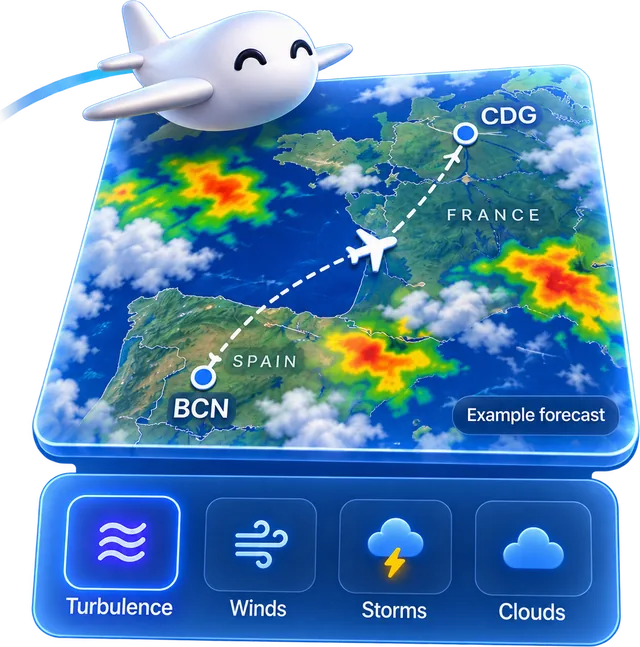
- ✓The turbulence forecast for your exact flight, refreshed as new weather comes in
- ✓Delays and gate changes on your Lock Screen, before the departure board
- ✓Where you are in the flight, and how long until the bumpy stretch is behind you
One fatal accident, in December 2024
On 29 December 2024 flight 2216, a 737-800 arriving from Bangkok, struck a flock of birds as the crew went around at Muan, in the south-west of South Korea. Landing from the opposite direction minutes later, it touched down without its landing gear down, ran off the end of the runway and hit a concrete embankment that held the localizer, an antenna that guides landing aircraft. 179 of the 181 people on board lost their lives; two cabin crew survived. It was the worst accident on South Korean soil.
Korea's investigators confirmed in their preliminary report, in January 2025, that the aircraft had hit birds — Baikal teal remains were found in both engines — and that both flight recorders stopped about four minutes before the impact. No cause has been published yet: a briefing planned for July 2025 was withdrawn after families objected to it, and the board missed its own target of June 2026 for a final report. To make it independent, the investigation board was moved in 2026 from the transport ministry to the Prime Minister's Office. The investigation is ongoing.
The embankment has been examined on its own. In January 2026 the transport ministry told the National Assembly that the structure at Muan did not meet airport safety standards, which call for anything that close to a runway to break away on impact, and a study commissioned by the government concluded the accident would most likely have been survivable had it done so. Concrete structures like it are being replaced with breakaway ones at Muan and other Korean airports, and bird-detection radar is being added at airports from 2026.
Jeju Air cut its schedule by 10 to 15 percent for the rest of that winter to give its aircraft more time for maintenance, and the government told Korea's low-cost airlines to fly each aircraft fewer hours a day and hire more engineers. Jeju Air is replacing its 737-800s with 737 MAX 8s.
Jeju Air first flew in June 2006, between Jeju and Seoul Gimpo, and is the largest of South Korea's low-cost airlines. Before 2024 it had never had a fatal accident; the most serious event was in August 2007, when one of its Dash 8 turboprops ran off the runway at Busan after a rudder fault, and everyone on board survived.
Every fatal accident, on one line
Solid dots are its own flights; hollow ones were flown by a partner or subsidiary under its name; grey rings are hijackings and attacks. Fatalities that investigators don't class as accidents (such as trespassers) aren't shown.
Each of these was investigated, and the lessons are built into how every airline flies today. The full list is here if you want it.
Read the full list (1)
- Dec 2024 7C2216 · Boeing 737-800 · Muan International Airport, South KoreaArriving from Bangkok, the aircraft struck a flock of birds as the crew went around; landing from the opposite direction minutes later, it touched down without its landing gear down, ran off the end of the runway and hit a concrete embankment holding the localizer antenna. 179 of the 181 on board lost their lives; two cabin crew survived. Korea's investigation is ongoing; no final report has been published.
Flying Jeju Air soon? See the bumps on your route
Enter where you're flying from and to. The forecast shows where the bumpy stretches are, how strong they'll be and when in the flight they come, from global weather forecasts and live pilot reports.
The day you fly, in the departure airport's own calendar.
Jeju Air in numbers
What Jeju Air flies
Tap a plane for its own safety record.
Jeju Air safety questions
How safe is Jeju Air?
Jeju Air has had one fatal accident in twenty years of flying: flight 2216 at Muan, South Korea, in December 2024, in which 179 of the 181 people on board lost their lives. The investigation is still open. On airlines like Jeju Air, the chance of being in a fatal accident is about 1 in 80 million per flight. Every fact on this page is sourced — the list is at the bottom.
What happened on Jeju Air flight 2216?
On 29 December 2024 the 737-800 from Bangkok struck birds as the crew went around at Muan, landed minutes later without its landing gear down, ran off the end of the runway and hit a concrete embankment holding a landing antenna. 179 of the 181 people on board lost their lives. Korea's investigators have confirmed the bird strike; no cause has been published yet, and the investigation is ongoing.
What has changed since flight 2216?
Concrete structures near runway ends like the one at Muan are being replaced with breakaway ones at Korean airports, and airports are adding bird-detection radar. Jeju Air cut its schedule that winter to give its aircraft more maintenance time, the government told Korea's low-cost airlines to fly each aircraft fewer hours a day and hire more engineers, and Jeju Air is replacing its 737-800s with 737 MAX 8s.
Where these facts come from
Every fact on this page comes from official accident reports, the airline's own figures or the published accident record.
- Wikipedia founding, bases, fleet types
- Herald Business (Jun 2026) fleet, passengers since 2006
- Wikipedia Flight 2216: timeline and investigation
- Gulf News (Reuters) ARAIB preliminary report, Jan 2025
- CBS News (AP) preliminary report: bird remains in both engines, recorders
- AeroTime Muan localizer structure, Jan 2026
- News1 via Daum (Jul 2026) investigation status, no final report
- Travel Extra schedule cut after the accident
- Bloomberg flight-hour limits and maintenance staffing
- B3A / Korea ARAIB report Flight 502 at Busan, 2007
- Airguide IOSA history
- IATA IOSA registry IOSA registration (NOT yet read — Cloudflare; check in a browser)
- MIT News / Journal of Air Transport Management (Barnett, 2024) risk per flight 2018–2022
Flying Jeju Air soon?
FlyBud shows the exact aircraft on your flight and the turbulence forecast for your route.